
Greenville County VINE Coverage
South Carolina VINE is the state's custody and supervision notification network. It covers participating county detention centers, SCDC, and SCDPPPS custody or supervision sources. The official FAQ describes feeds from county detention centers and state systems and reports an update cycle of 15 minutes. Juvenile agencies may be monitored, but juveniles cannot be displayed. Federal BOP and ICE custody are outside this network.
Use the official South Carolina VINELink portal for a specific adult. Web, mobile, telephone, email, SMS, and TTY options may be available. The statewide multilingual telephone service is 1-866-727-2846 and operates around the clock. The program email is scvine@doc.sc.gov. These channels support status checks and alerts, not a public Greenville County recent-release list.
VINE and VINELink refer to related parts of the service. VINE is the notification network. VINELink is its public search and registration interface. Neither replaces a jail release record, court disposition, or SCDC release entry.
The official South Carolina VINELink interface shows the search, custody-result, and notification workflow.
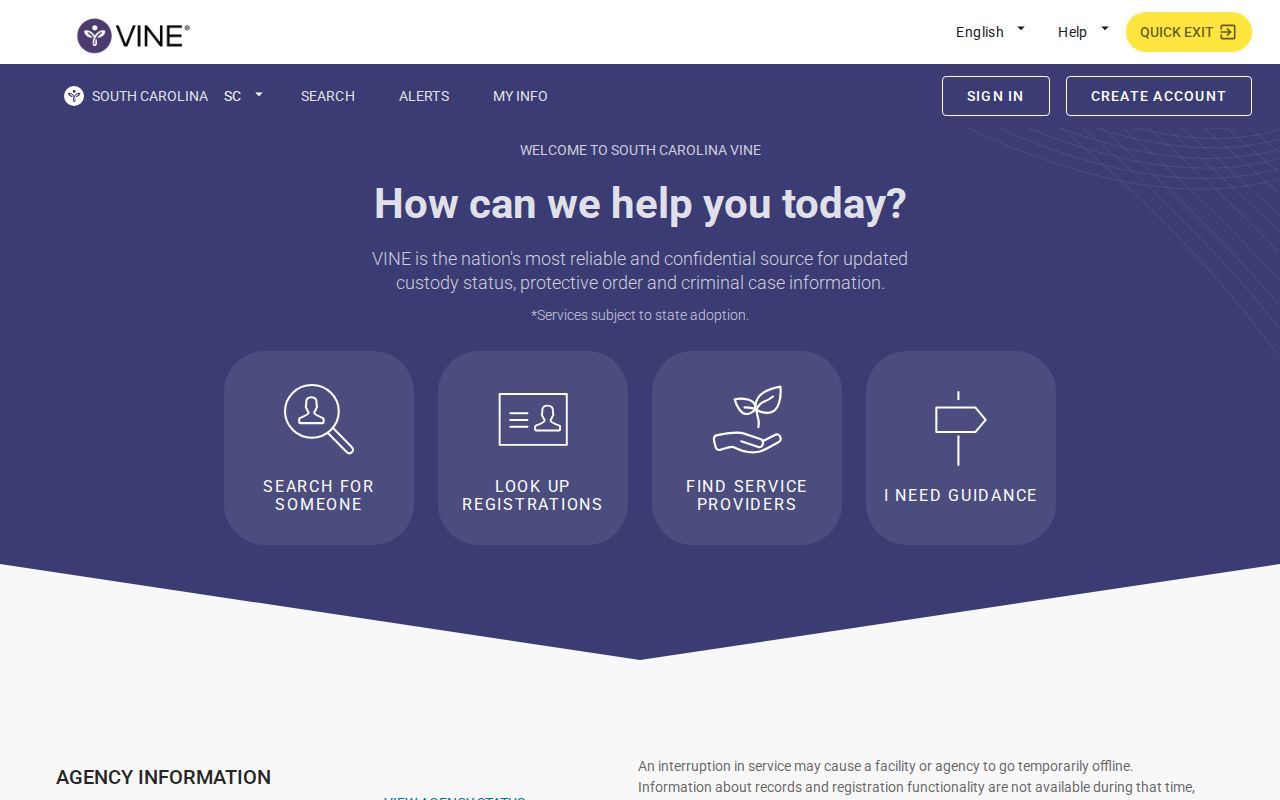
The captured interface supports the person-specific search and alert process, but no private identity needs to be republished to explain it.
Search a Greenville Inmate on VINE
Start with the strongest identifier available. Exact spelling matters, and a middle initial or date of birth can help separate people with similar names. An offender number is stronger when known. Do not choose a result based only on a common first and last name.
- Open South Carolina in VINELink and choose the offender or inmate search.
- Enter the adult's name. Add a middle initial and date of birth when available, or use the offender number.
- Compare the returned identity details before opening a record.
- Review the displayed custody status and location, then note which agency supplies the record.
- Confirm a release, transfer, or date with GCDC, SCDC, SCDPPPS, or the relevant court.
If no record appears, correct the spelling and identifiers before drawing a conclusion. The official FAQ says VINE cannot track an adult who is on bond or otherwise out of custody. No available custody information can therefore indicate release, but it may also reflect a transfer, lag, unmatched identity, or a source that VINE does not cover. The full Greenville County released-inmate search adds the official record channels needed for confirmation.
Greenville VINE Release Information
The exact labels can vary with the source agency and record state. Research did not reproduce a private person's result card, so no unverified released-result label is promised. Use the fields that appear to match identity and custody, then verify the operational event with its source.
| Information | How to read it |
|---|---|
| Name and identifying details | Help distinguish the intended adult from a namesake. |
| Offender number | Links the person to the agency record more reliably than name alone. |
| Custody status | Indicates the status supplied to VINE, subject to feed timing. |
| Facility or location | Identifies the agency to contact and may reveal a transfer. |
| Notification options | Shows which custody-change alert channels can be registered. |
A status or location is not the same as a court result. The court may show bond, dismissal, sentence, or another order. GCDC confirms whether physical release occurred. SCDC's dedicated released search supplies actual Release Date and Release Type for state custody. Keep those records separate from the VINE indicator.
Register Greenville County Release Alerts
Registration begins only after the correct person has been selected. Choose a channel that can be monitored and keep the contact details current. Notifications can cover release, transfer, or another custody change depending on the source record and available options.
- Select telephone, valid email, SMS-capable mobile phone, or TTY when offered.
- Choose English or Spanish for the notification.
- For telephone alerts, create a four-digit PIN and keep it available.
- Enter that PIN when the automated call arrives to acknowledge the notice.
- After an agency transfer, search the destination record and register again.
Telephone calls repeat for up to 48 hours or until the four-digit PIN is entered. Email and text registrations do not use the phone PIN. Registration is described as anonymous and confidential from the offender. Still, a notification is a prompt to verify, not a complete release certificate. Contact the agency shown on the record for actual timing and release type.
Note: Keep the PIN private and update the registered contact channel so an important custody-change notice is not missed.
Greenville VINE Alerts After Transfer
A Greenville County registration does not automatically follow a person into another agency. This local layer matters when someone moves from GCDC to SCDC. Search for the destination record and register again. A disappearing county record may mark that transfer, not a return to the community. The receiving system becomes the next source of custody facts.
For an SCDC prisoner, formal crime-victim registration belongs with SCDC Victim Services at 803-896-1733 or 1-800-835-0304. The Greenville Solicitor also explains that bond-out notification can depend on correct information being provided to the reporting officer or on the victim notifying GCDC. Contact information must remain current. This local notification route supplements VINE; it does not alter the court order or jail release process.
VINE's stated 15-minute cycle describes source-data refresh, not a guaranteed local delivery time for every operational event. A transfer can require the old and new agency feeds to change at different times. Search the destination and call the custodian when timing is critical.
Confirm a Greenville VINE Release
For a GCDC event, call 864-467-2309 or visit 20 McGee Street. Ask whether the person remains confined, whether judicial release authorization arrived, whether physical release finished, and whether another agency assumed custody. Then match the answer with the correct Greenville court record. A roster disappearance or VINE absence should not be translated into a precise release time.
For an SCDC event, use the SCDC Released Inmate Search. It accepts a date range and county and displays Release Date and Release Type. The ordinary SCDC search covers current inmates and excludes released people, so it serves a different purpose. If the type indicates probation or community supervision, check SCDPPPS to learn whether oversight continues.
Greenville VINE Check Limits
VINE cannot display juveniles, does not track adults on bond or out of custody, and does not cover federal BOP or ICE custody. A BOP release must be read through the national BOP locator and federal docket. Possible ICE detention uses the current ICE locator and its information line. A no-result in either authority-specific system has narrow meaning and does not prove that every form of custody ended.
VINE also does not supply the durable field set of a county release record. It should not be used to infer a release reason, court disposition, or exact physical exit time that the source does not display. For documentary proof, request the admission and release record, including actual date and time, authority, type, destination, and holds. Ask the custodian for its retention schedule if the record cannot be found.
Four separate state milestones should never be collapsed into one alert: projected parole eligibility, a scheduled Board hearing, the Board decision, and actual SCDC release. Eligibility is only the point at which consideration may occur. A hearing is not an outcome. A grant supplies authority but may precede the gate event. The SCDC release result and any SCDPPPS supervision record complete the chain. VINE may notify a custody change, but it does not rewrite those records.
A GCDC bond event has its own two-stage sequence. Payment or a court entry does not complete release. Judicial authorization must reach the Detention Center before processing begins, and GCDC then confirms the physical exit. The facility reports a goal of completing release within four hours after receipt, subject to emergencies or exigent circumstances. A VINE alert received during that process should be checked against GCDC's direct answer.
For a formal county record, identify the adult by full name, date of birth, booking number if known, and approximate booking date. Ask separately for the admission record, actual release date and time, authority, release type, receiving agency, holds, and booking photograph. Electronic delivery and a cost estimate can be requested. If nothing is found, ask which retention or disposition schedule applied instead of assuming the event never occurred.
South Carolina public-record timing is separate from notification timing. A VINE update may arrive quickly, while a formal request follows the agency's determination and production process. Recent jail-identification documents from the preceding three months generally must be available for in-person inspection without a written request unless an exemption applies. That access floor does not create an online release archive. If information is withheld, request the cited exemption and any segregable portion that can be released.
Identity errors also deserve care. A name match alone may join the wrong person to a custody event. Compare the offender number, date of birth, agency, and location before registering. When VINE and an agency record conflict, contact the source agency instead of choosing the result that appears newer. Greenville's current roster changes quickly, the SCDC current search reflects the preceding midnight, and VINE reports a different feed cycle. Each timestamp describes its own system.
Save the source name, the status shown, and the time checked when reconciling an alert. Then record the agency's direct confirmation and any court event separately. This simple audit trail prevents a later VINE update from being mistaken for the original release time and keeps a transfer notice distinct from a discharge to the community.
- Release
- Departure from one custodian; another authority may still take custody.
- Transfer
- A move between custodians, not a community release.
- Supervision
- Legal oversight after institutional custody, such as parole, probation, or community supervision.
- Detainer
- A request or hold that may send the person to another authority.