
Greenville Projected and Actual Dates
SCDC defines Projected Release Date as the date it currently expects an offender to satisfy all incarcerated terms, assuming work, education, and good-time credits continue at the present rate. The agency also describes it as a projected maxout date. It can move when credits, discipline, or sentence information change. Projected Parole Eligibility is a different field. It identifies possible parole eligibility or, in some cases, a scheduled hearing date.
An actual release date records an event that has already occurred. For state custody, SCDC's dedicated released search supplies Release Date and Release Type. For GCDC, the Detention Center or a county release or transfer record must confirm the event. A pretrial detainee often has no fixed projected date because release depends on the court, bond, holds, and processing rather than a final prison sentence.
| Date or event | Meaning | Official source |
|---|---|---|
| Projected Release Date | Current SCDC estimate based on sentence and assumed future credits | SCDC current-inmate detail |
| Projected Parole Eligibility | Possible eligibility or hearing timing | SCDC detail and Board search |
| Judicial authorization | Legal authority sent to a jail | Court and GCDC |
| Actual release date/type | Completed state release event | SCDC Released Inmate Search |
Search Greenville State Release Dates
The SCDC current inmate search covers people currently sentenced to and incarcerated in SCDC. Its information is refreshed as of midnight on the preceding day. The individual detail report contains the projected release and projected parole eligibility fields. It excludes released people, county detainees, parole and probation cases, juveniles housed with SCDC, and current fugitives. That scope rule prevents a common error: the current search is not a historical released-person database.
- Confirm that SCDC, rather than GCDC, holds the person. Use the SCDC number when available and compare identity details.
- Open the current detail and read Projected Release Date separately from Projected Parole Eligibility.
- Review the sentence and offense dates. Do not apply an 85-percent rule to every case.
- If the current record disappears, check the SCDC Released Inmate Search by date range and Greenville county.
- Call SCDC Inmate Records at 803-896-8531 when sentence inputs or projected fields remain unclear.
The official calculator helps illustrate the assumptions behind a projected date. View the SCDC Release Date Calculation source before treating its result as final.
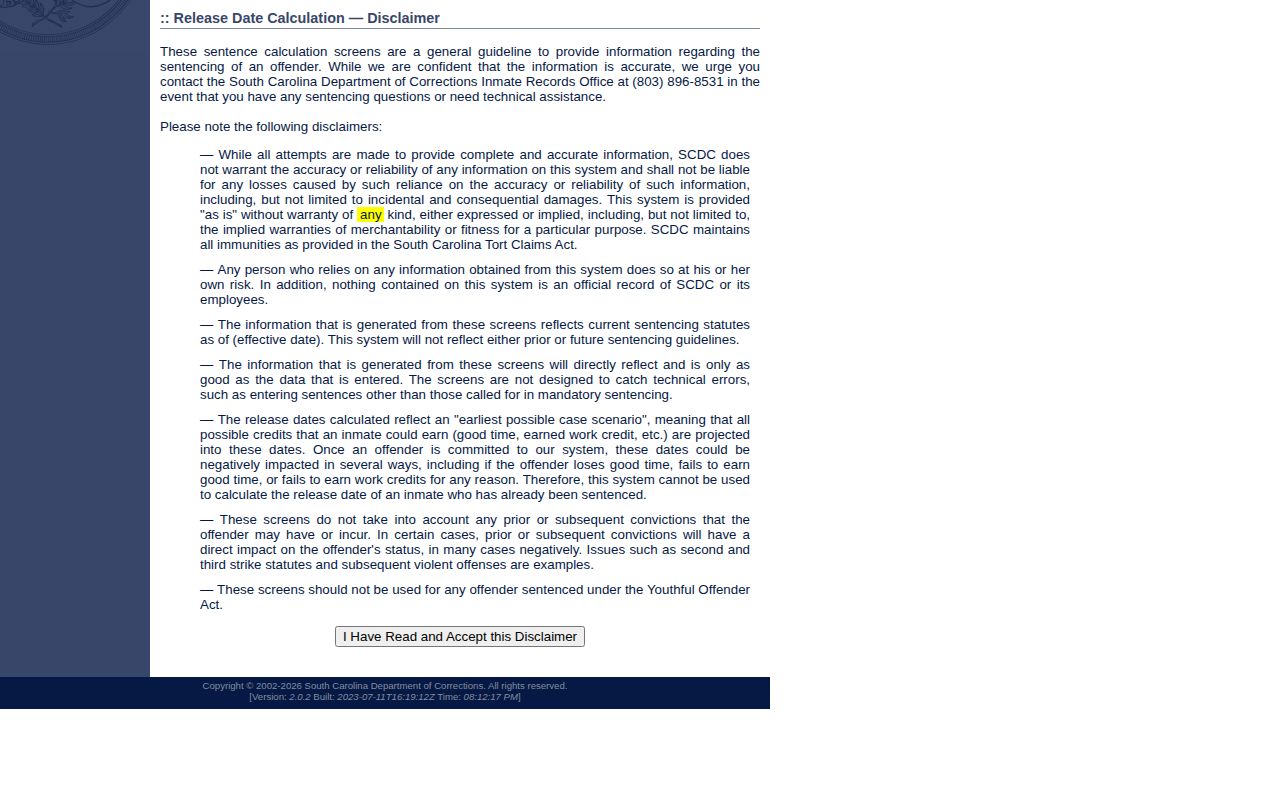
The calculator describes an earliest possible case and warns that credits may be lost or not earned. It is not an official calculation for a named inmate.
Greenville County Jail Release Dates
A GCDC detainee does not belong in the SCDC projection tool merely because both systems are in South Carolina. For a pretrial person, check the current Incarcerated Inmates tool, then contact the Greenville County Detention Center at 864-467-2309. Ask whether the person remains confined, whether judicial authorization arrived, whether physical release finished, and whether another agency placed a hold or took custody.
A county-sentenced prisoner has a different credit rule. South Carolina Code §24-13-210(C) provides one day of deduction for every two days served when a person sentenced to a local detention facility or county public works follows institutional rules. This does not apply to a pretrial detainee waiting for disposition. The local official can forfeit credit after misconduct, and the actual calculation must come from GCDC and the sentencing court.
Greenville County Detention Center
20 McGee Street
Greenville, SC 29601
864-467-2309
Fax: 864-467-2324
The county FAQ gives a goal of physical release within four hours after GCDC receives judicial authorization. Emergencies or exigent circumstances may delay processing. The benchmark starts when authorization reaches the facility, not when bond is paid or an order first appears on a docket.
Greenville Sentence Credit Rules
South Carolina's credit framework depends on the offense and sentence. Section 24-13-100 defines a “no parole offense” through felony classification and statutory maximum terms. Under §24-13-150(A), most people serving such an offense cannot receive early release, discharge, or community supervision before at least 85 percent of the actual unsuspended term. The floor is computed without credits, and credits cannot reduce the term below it. This is not a universal rule for every inmate.
For offenses outside that category, §24-13-210(A) allows a qualifying SCDC prisoner 20 days per month served for faithful rule compliance. Subsection (B) provides three days per month for qualifying no-parole offenders, subject to exclusions and the statutory floor. Credits may be forfeited after misconduct. Section 24-13-230 also permits work and education credits: up to one day for each two days in a qualifying program for a person not serving a no-parole offense, subject to an annual combined cap, while the statute uses a different monthly rule for no-parole offenses.
- Good-time credit
- A sentence deduction tied to compliance with institutional rules.
- Work or education credit
- A deduction earned through qualifying productive duty or instruction.
- No-parole offense
- A statutory category with special release and credit limits; it is not identical to every violent offense.
- Maxout
- The projected point when all incarcerated terms are satisfied under the current calculation.
Life and certain mandatory sentences have exclusions. Section 24-13-125 also restricts work-release timing for no-parole offenders. Only the responsible records office can apply all sentence data to a specific case.
Why Greenville Release Dates Move
A projection changes because it carries assumptions forward. SCDC's calculator assumes available credits in an earliest-possible case. A person may fail to earn them or lose them through discipline. Corrected commitment data, new sentences, prior or later convictions, and whether terms run together or one after another can also change the result. The public calculator omits prior and subsequent convictions and should not be used for Youthful Offender Act cases.
| Factor | Effect on the practical date |
|---|---|
| Credit not earned or forfeited | Projection may move later |
| Corrected sentence data | Term calculation may be revised |
| Consecutive or concurrent terms | Total custody period may change |
| Detainer or other-agency hold | Departure from one agency may become a transfer |
| Parole decision | Grant authorizes a path; denial means that proposed parole release did not occur |
A detainer deserves special care. It is a request by another authority concerning custody. Leaving SCDC or GCDC under a detainer may mean movement to another jail, federal custody, or immigration custody, not release to the community. Follow the receiving authority before describing the person as free.
Greenville Parole Dates Are Separate
Projected parole eligibility, a Board hearing, the decision, and actual release are four distinct milestones. The SCDPPPS hearing and result hub becomes searchable about 30 days before a hearing, but schedules can change. A grant does not prove the person has passed through the release gate. Compare the posted result with SCDC's actual Release Date and Release Type, then check Post-Release Supervision.
Eligibility turns on the offense, sentence, and offense date. Title 24, Chapter 21 contains the parole statutes, while no-parole restrictions and sentence-specific provisions can override a simple fraction of the term. Reading the projected field alone can therefore misstate the case. SCDC Inmate Records is the proper contact for sentence and release calculations.
Release date chain: projection → possible hearing → Board decision → actual release event → community supervision, if any.
Confirm Greenville Actual Release
For an SCDC case, use the dedicated released list, which accepts a date range and county and reports Release Date and Release Type. Observed types include RELEASED, PROBATION, and COMMUNITY SUPV. These fields record departure from SCDC, but probation or community supervision points to SCDPPPS. A detainer can point to continued custody elsewhere.
For GCDC, call or visit because the county publishes no historical released archive. The Greenville County Detention Center page identifies the questions to ask. If written proof is needed, request the actual release or transfer date and time, release authority or disposition, receiving agency, and holds reflected at release. Give a full name, date of birth, booking number if known, and approximate booking date.
SC VINELink can supply a custody-change alert, but it is an indicator rather than the final record. Its data refresh every 15 minutes, and a registration does not follow a person across agencies. The VINE Inmate Check covers re-registration after transfer. Confirm the operational event with GCDC, SCDC, or the destination custodian.
Request Greenville Release Date Records
A written record is useful when an online projection has changed or a roster no longer shows the person. Greenville County accepts a letter or its FOIA request form. Send a detention request to GCDC or the proper county custodian and reasonably describe the record. Include full name, date of birth, booking number if known, and an approximate booking date. Ask for electronic delivery and a fee estimate before costs pass a stated limit.
Request the booking or admission record, actual release or transfer date and time, release authority or type, disposition, receiving agency, and holds shown at release. Those fields distinguish a completed community release from movement to another custodian. If the office cannot locate an item, ask for the applicable retention or disposition schedule rather than assuming no event occurred.
Under the county's explanation of §30-4-30(C), the determination period is ten business days for records less than 24 months old and twenty business days for older records. Once access is granted, production is due within 30 calendar days, or 35 days for older records. A required deposit can start the production clock. These are public-record process deadlines, not real-time custody checks. Call GCDC first for a recent event.
For SCDC documents, identify the SCDC number, name, date range, and precise sentence or release fields. Send documentary requests through SCDC legal and FOIA information. The public calculator expressly disclaims official-record status, so ask Inmate Records for questions about the agency's calculation and use FOIA when the underlying releasable document is needed.
Save the source date with each result. A projected field may change after the capture, while an actual release entry records a past event. When a correction arrives, retain the newer agency response with the older search result so the reason for the difference remains clear.
Public Record Search
Sponsored Results
Confirm Greenville Release Completion
A projected date ends the inquiry only when the goal is planning. To prove that custody ended, use the record created by the custodian. For a Perry or other SCDC prisoner, search the dedicated Released Inmate Search and read Release Date with Release Type. For a county sentence, contact GCDC and pair its actual release entry with the sentencing court record.
Ask whether a detainer, new order, or receiving agency changed the outcome. Departure from SCDC or GCDC may be a transfer. A parole grant, eligibility date, calculator result, or docket entry can explain authority and timing, but none alone proves the moment of physical release.